From 30 turbines to nine: the economics behind Asja’s Sicilian wind repowering
Intesa Sanpaolo has financed the redesign of the Alia-Sclafani wind farm. The investment case turns on the electricity the new machines can deliver and the revenue lost while the old ones come out.
What is being financed at Alia-Sclafani?
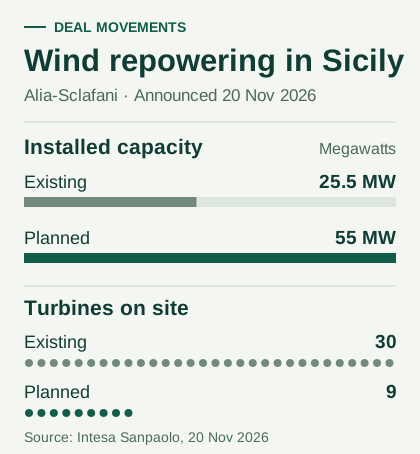
On 20 November 2026, Intesa Sanpaolo announced €67 million of financing for Asja Energy’s Alia-Sclafani wind farm in the province of Palermo. The plan covers the existing site across Alia, Sclafani Bagni and Valledolmo. Asja and the bank say the project would replace 30 turbines with nine and increase installed capacity from 25.5 MW to 55 MW. Neither announcement gives a commissioning date. [1] [2]
That is a planned gain of 29.5 MW, or roughly 116%, with 21 fewer turbines. Those are straightforward calculations from the published design. Annual generation will depend on the wind resource, the new machines’ performance, availability and the electricity the grid can accept. The announcements give no annual generation forecast. [1] [2]
What does the incentive announcement establish?
Intesa says the project secured a qualifying position in the December 2025 ranking published by Italy’s energy services agency, GSE, for access to the transitional FER X incentive. The public financing release does not specify the project’s tariff, remaining milestones or start of payments. An investment team needs those terms to turn project eligibility into a dated revenue forecast. [1]
How should an owner compare repowering with continued operation?
REN analysis. Start with two sets of monthly cash flows from the same decision date. One retains the existing equipment, including its inspection costs, expected availability and remaining operating life. The other includes dismantling, construction, grid works, lost sales during the outage and the forecast net export of the replacement turbines. Using the same wind and power-price assumptions in both cases makes the incremental benefit easier to see.
Then move the energisation date by one season. The owner needs to know which civil works, crane reservations or grid tests move with it, which payments still fall due, and whether the interest reserve covers the delay. A lender needs a clear release test for construction funding. An operator needs the warranty, acceptance and outage records that will let it pursue a claim if an individual machine underperforms.
The public €67 million figure identifies financing provided. A full capital budget, debt terms and the sponsor’s equity contribution would be needed to infer leverage or a return on invested capital. [1] [2]
Sources
- Intesa Sanpaolo · financing announcement, 20 November 2026 (Italian)
- Asja Energy · owner’s project announcement, 20 November 2026 (Italian)
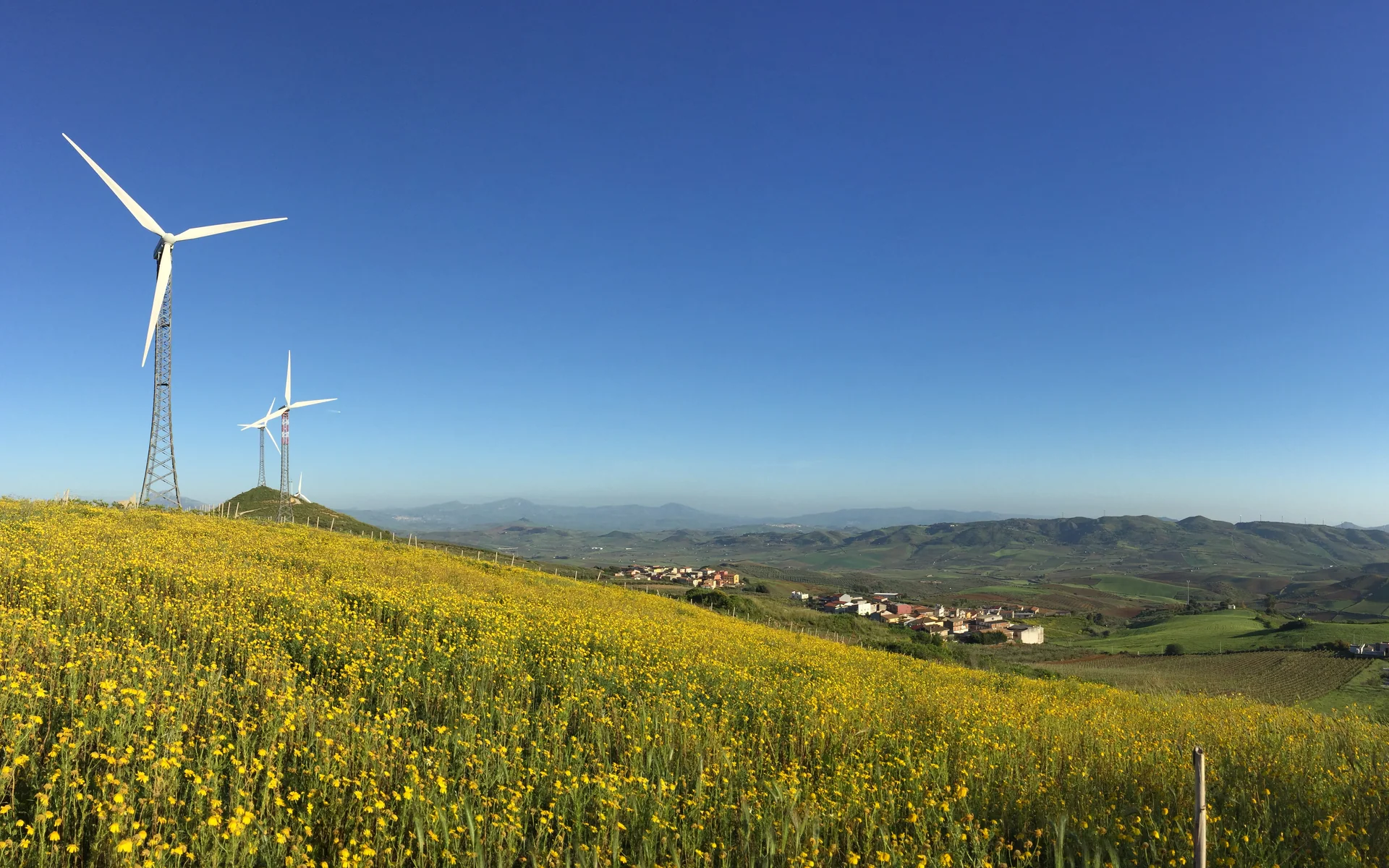
Illustrative photograph. Wind turbines in the hills above Grisì, Sicily by G411993. Cropped and converted to WebP. CC BY-SA 4.0.
